Do AI video models understand physics?
Do AI video models understand physics? The benchmarks say not yet. What Physics-IQ, VideoPhy and other tests found, where the models fail and what kind of data could help.
By Paul Botha,
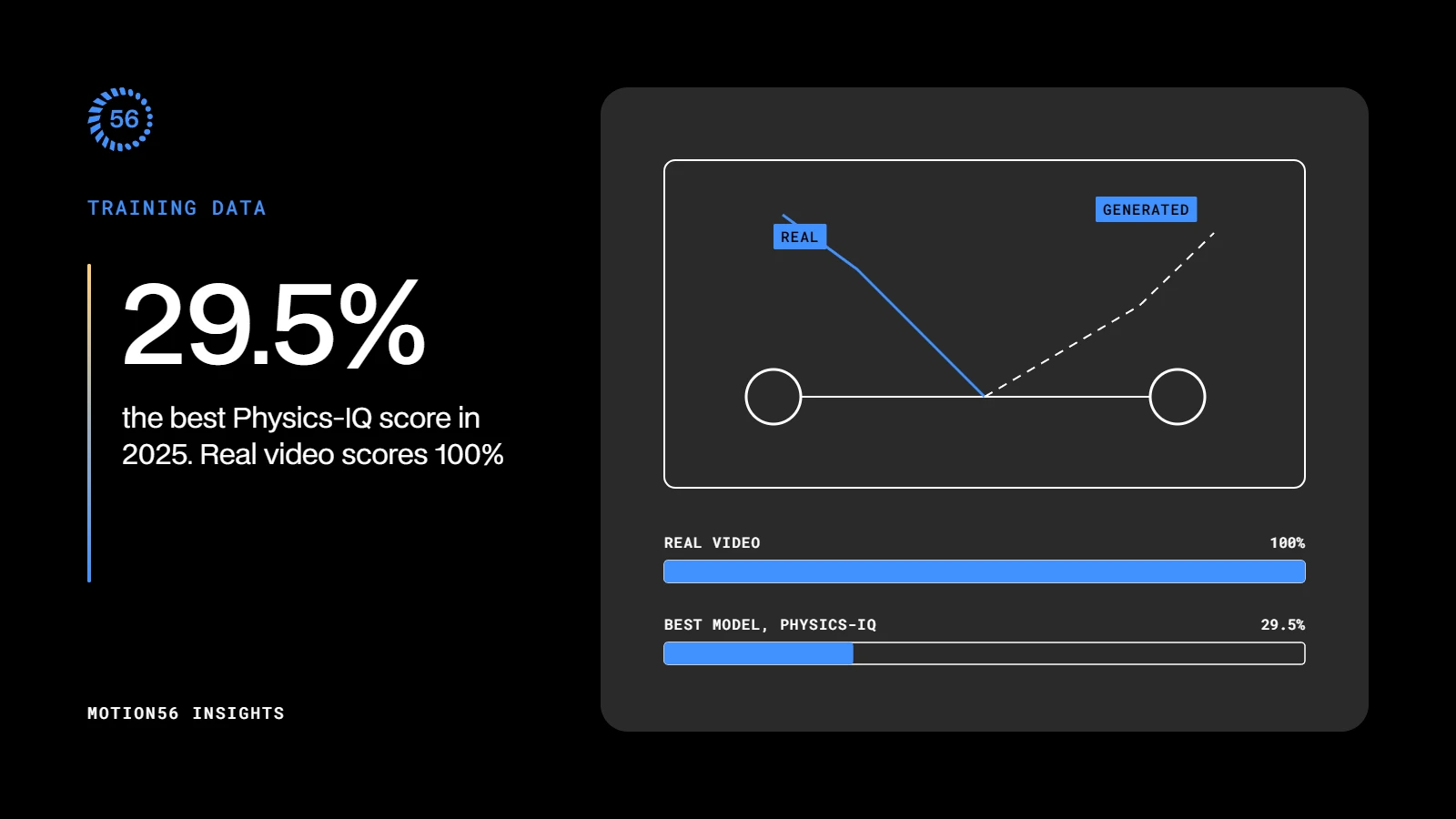
Not yet. On Physics-IQ, a 2025 benchmark from Google DeepMind and INSAIT, pairs of real videos score 100%, the best model tested scored 29.5% and Sora 10.0%. Other benchmarks agree: models produce realistic-looking video that breaks the rules of collisions, mass and momentum.
How do you measure physics in AI video?
You show a model the start of a real event and ask it to continue, or give it a prompt that implies a physical outcome, then compare what it generates with what should happen.
Physics-IQ (2025) covers solid mechanics, fluid dynamics, optics, thermodynamics and magnetism. The best score was 29.5%, Runway Gen 3 scored 22.8% and Sora 10.0%.
VideoPhy (ICLR 2025): the best model got both the prompt and the physics right in 39.6% of cases. Every model did worst on solid objects interacting, where the best managed 24.4%.
VideoPhy-2 (2025): the best model scored 22% on the hard subset, struggling with conservation of mass and momentum.
PhyGenBench (ICML 2025): 160 prompts covering 27 physical laws. The best model scored 0.51 out of 1.
Scores move as models and benchmarks are revised, so treat these as a snapshot of 2025, not a league table.
Why do AI videos get collisions wrong?
Because the models imitate rather than reason. A 2024 study by ByteDance researchers trained video models on simple simulated physics. Within the range of their training data they were near perfect. Outside it they failed, copying the closest example they had seen, and matching on colour first, then size, then speed, then shape.
Scaling alone is insufficient for video generation models to uncover fundamental physical laws.
Kang et al., How Far is Video Generation from World Model, 2024
The study used a 2D simulator rather than real video, but the lesson carries over: a model can only reproduce physics it has seen in enough combinations.
That has a practical consequence for data. A model trained on a narrow set of collisions will fill every new collision with the nearest one it knows. Breadth of real examples, not just volume, is what gives it something better to draw on.
Do models handle water, fire and smoke better?
Somewhat. The Physics-IQ project page notes that fluid dynamics tend to work better than solid mechanics, and VideoPhy's best model scored 44.0% on fluids meeting fluids. There is no reliable headline score for fire and smoke yet, partly because automatic judges also get combustion wrong.
Why does this matter for anyone using video models?
Because looking real and being right are different things, as the Physics-IQ authors put it. A clip for an advert can get away with water that flows slightly wrong. A model used to simulate a warehouse, train a robot or test a car cannot. The more video models are used as simulators, the more their physics matters.
The benchmarks are moving too. Physics-IQ was re-scored in June 2026 as Physics-IQ Verified, and those scores are not comparable with the 2025 results above. What has not changed is the gap between generated video and the real thing.
What would help AI video models understand physics?
Real footage of real events, where physics was never simulated: collisions, falls, splashes, fires and storms.
Coverage of combinations: the same event at different speeds, sizes, materials and angles.
Footage from many cameras and conditions, so models learn the event rather than the camera.
Descriptions of what happens and when, so teams can find the moments that matter.
Evaluation on real video the model has never seen, as Physics-IQ does.
Motion56's Natural world data set covers wildlife, weather, landscapes and the sea, above and below the surface: hard conditions for a model, and hard footage to find. Alongside it we license real incidents caught on dashcams, CCTV and phones. See training data for the four data sets, and synthetic vs real training data for where generated footage helps and where it does not.