How much does video training data cost?
What does video training data cost? The public price points, why video is priced by the hour and what moves the price of an hour up or down.
By Paul Botha,
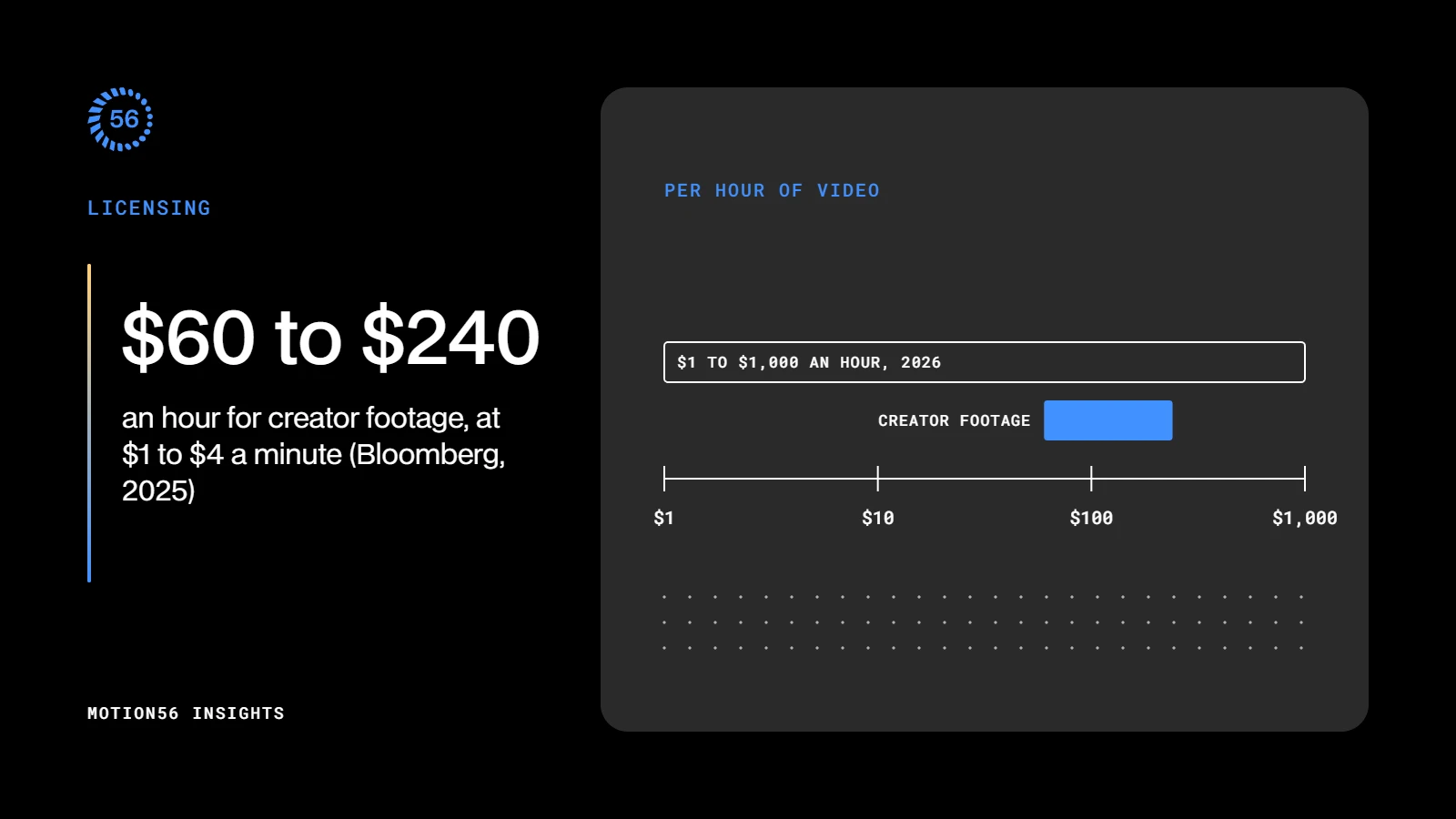
Public reports put creator footage at $1 to $4 a minute for AI training, or $60 to $240 an hour. One licensor quotes $1 to $1,000 an hour, depending on the use and the tagging. What an hour is worth turns on rarity, description, exclusivity and how clean the rights are.
How much do AI companies pay for video training data?
The most quoted figures come from Bloomberg, which reported in January 2025 that AI companies were buying unpublished footage directly from creators to train video models.
AI companies are currently paying between $1 and $4 per minute of footage.
Bloomberg, 10 January 2025
Most of that footage sold for $1 to $2 a minute, according to the same report. 4K video, drone footage and other unusual material sold at the top of the range. PetaPixel's summary of the Bloomberg report is free to read.
A year later the published range was much wider. In January 2026, The Media Leader reported that Veritone charges between $1 and $1,000 per hour of video, depending on the application and the tagging and metadata available.
Put side by side, the public price points look like this:
$1 to $2 a minute ($60 to $120 an hour): most unpublished creator footage (Bloomberg, January 2025).
Up to $4 a minute ($240 an hour): 4K, drone and other unusual footage (Bloomberg, January 2025).
$1 to $1,000 an hour: one licensor's range, depending on the use and the tagging and metadata that come with the footage (The Media Leader, January 2026).
Why is video priced per hour?
AI teams plan by volume. A brief usually says how many hours of a kind of footage a model needs, so the hour is the unit both sides can count. Sellers often think in clips or minutes, so it helps to convert: multiply a rate per minute by 60. $2 a minute is $120 an hour.
Motion56 prices licences per hour of content and quotes against each brief, because the same hour can be worth very different amounts to two buyers.
What makes one hour worth more than another?
Rarity. Footage that cannot easily be filmed again, or has never been published, is worth more than footage a team could collect or find elsewhere.
People and consent. Footage of real people is in demand, and the paperwork behind it matters as much as the pictures.
Original audio. Speech and natural sound give speech and multimodal teams a second signal to train on.
Description. Footage described by what happens in it can be selected against a brief. Footage with no description has to be watched first.
Exclusivity. An exclusive licence costs more than a non-exclusive one.
Term and territory. How long the licence lasts and where it applies.
What does metadata add to the price?
Metadata is what lets a buyer find the right footage, and it is a large part of the gap between the low and high ends of the ranges above. Veritone's own example shows the scale of the work: it processed 500,000 hours of video to deliver 26,000 hours for one model, according to The Media Leader. That is about 5% of what was reviewed.
Motion56's metadata services describe footage for AI training at three published prices per hour of video: Basic at $0.50, Mid at $1.00 and Complex at $2.00. Set against licence rates of tens or hundreds of dollars an hour, description is a small cost.
What does a content owner receive?
That depends on the agreement. A licensor such as Motion56 finds the buyers, handles the contracts and pays the owner a share of every licence, and the owner keeps ownership.
As an illustration only, 1,000 hours licensed at up to $140 an hour would be up to $140,000 of licence value. What an owner receives depends on their agreement with us. This is not an offer or a guaranteed rate. Our post on what buyers look for covers which footage sells.
How to plan for video training data cost
For AI teams, three questions set the budget before any rate is discussed:
How many hours does the model need, and how many of them must be new to it?
How specific is the footage? A narrow brief, such as dashcam footage at night in rain, is harder to fill than broad real-world video.
What has to come with it: original audio, time-based descriptions, consent records, exclusivity?
Our guide to how AI training data licensing works covers what a licence includes and how a brief becomes one. To price a specific brief, send it to us. We reply within one working day with what we hold.