Dashcam training data: why real crashes are so scarce
Dashcam training data teaches driving and fleet safety models what a crash looks like before it happens. Why real crashes and near-misses are scarce, and what the open datasets hold.
By Paul Botha,
Dashcam training data is video from forward-facing cameras in real vehicles, used to train models that spot hazards, predict collisions and coach drivers. Normal driving is easy to collect. Real crashes and near-misses are not: the largest open crash sets hold thousands of clips, against millions of hours of ordinary driving.
What is dashcam training data used for?
Forward collision warning and accident anticipation, which need the seconds before an event.
Driver coaching and fleet safety scoring.
Triage of insurance claims and incident review.
Testing driver assistance systems against real scenes rather than staged ones.
Why are real crashes and near-misses so hard to find?
Because crashes are rare for any one camera, even though they are common across the world. The World Health Organization estimates about 1.16 million road deaths in 2025, while noting that the death rate fell 21% between 2011 and 2025.
All road deaths are preventable and none are acceptable.
Dr Tedros Adhanom Ghebreyesus, World Health Organization, 20 July 2026
Most dashcams record years of uneventful driving and are overwritten. The footage that matters is the few seconds before something goes wrong, and it is scattered across millions of cameras and owners.
What is accident anticipation?
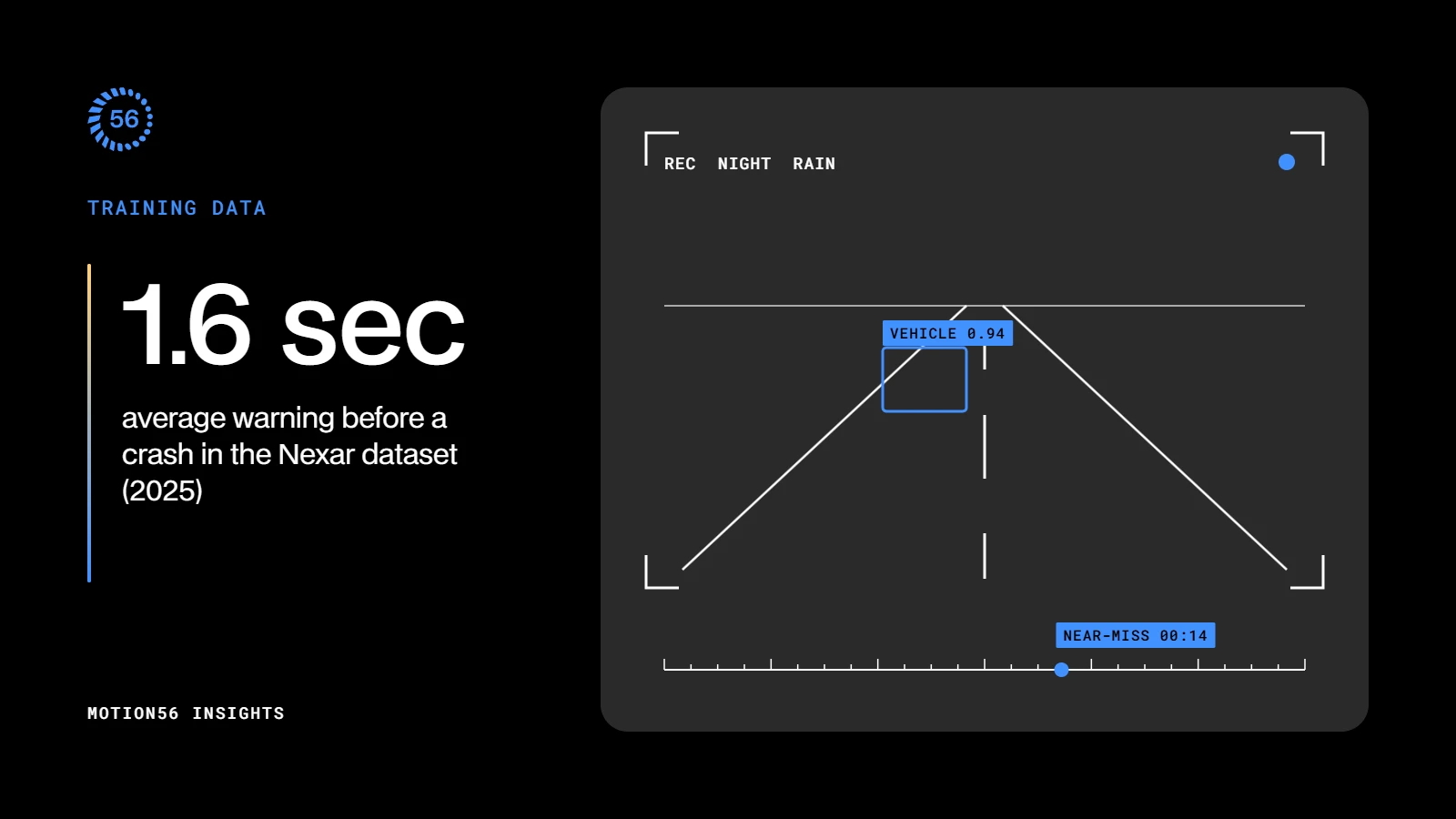
It is predicting a crash before it happens, so a system can warn the driver or act. The window is short. In the Nexar dataset the average gap between the moment an alert could be raised and the event is 1.6 seconds, and the longest is 4.5 seconds. A model has to learn what those seconds look like, which means it needs the run-up to many real events, not just the impact.
It also needs plenty of normal driving, so it learns what is not dangerous. The Nexar set balances 750 events with 750 normal clips, and DAD pairs 620 accident clips with 1,130 normal ones. Without that balance a model raises false alarms, and drivers learn to ignore it.
Which open dashcam datasets exist, and how big are they?
BDD100K (2018): 100,000 videos of about 40 seconds each, more than 1,000 hours of mostly normal driving.
Nexar Collision Prediction (2025): 1,500 clips, of which 400 are collisions, 350 near-collisions and 750 normal driving. The average gap between the alert and the event is 1.6 seconds.
DAD (2016): 1,750 clips of 5 seconds from Taiwan, 620 of them accidents.
CCD (2020): 1,500 accident videos trimmed from YouTube.
MM-AU (2024): 11,727 accident videos in 58 categories, free for non-commercial use only.
Two things stand out. The sets are tiny next to the volume of normal driving, and several carry non-commercial terms or were built from online video whose rights sit with the people who filmed it.
What makes good dashcam training data?
The run-up. Several seconds before each event, because anticipation is the task.
Conditions. Rain, night, glare, snow and low sun, where cameras and models struggle.
Roads. Roundabouts, junctions, rural lanes, and both left-hand and right-hand traffic.
Cameras. Many makes, mountings and resolutions, so a model does not learn one device.
Description. What happens and when, clip by clip, so a team can select by event.
Rights. A clear chain from the driver who filmed it to the licence.
Can police dashcam submissions be used to train AI?
No. In the UK, drivers can send footage of dangerous driving to the police through Operation Snap. Greater Manchester Police received 5,078 reports in 2023, up 36.7% on 3,715 in 2020. That footage is evidence for enforcement, not a dataset, and forces ask people not to report collisions through it.
Dashcam footage at Motion56
Motion56 licenses dashcam footage of real crashes and near-misses, in rain, at night and in glare, filmed by the drivers who were there, with what happens described on every clip. We warrant the rights to what we license and indemnify buyers against copyright claims.
Send a brief through training data and we will reply within one working day. For why real footage still beats generated scenes, see synthetic vs real training data.