The role of scripted content in generative AI production
Real-world footage teaches AI how life looks. Scripted content teaches it how a scene works. Here’s what that footage offers generative video, where it fits in production, and why performers’ rights have to come first.
By Ashleigh Johnson,
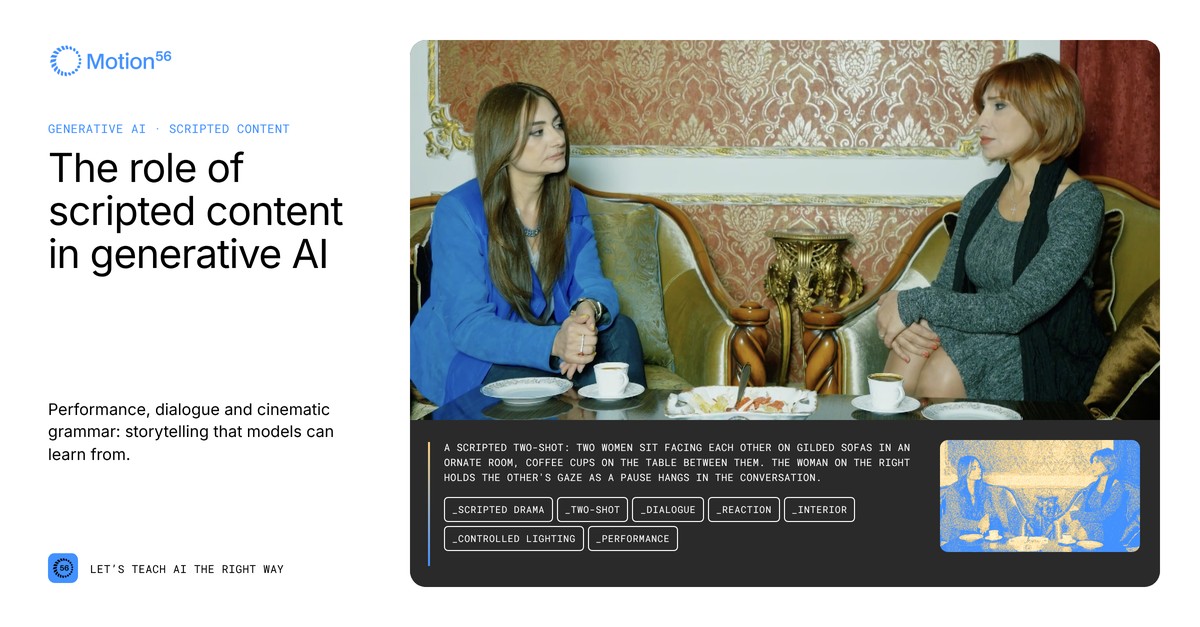
Generative video can now produce a convincing shot. A convincing scene is harder: two people talking over each other, one of them holding a look a beat too long, the camera cutting away at just the right moment. Models pick that up from footage where someone planned every one of those choices.
Scripted content is that footage. In drama, comedy, soaps and short films, the performance, dialogue, lighting and editing are all decided on purpose and designed to work together. A model that generates or edits video can learn a lot from that.
What scripted content teaches
User-generated footage is great for realism. Scripted footage gives a model something a phone video rarely can: every frame looks the way it does because someone meant it to.
Performance and emotion. Actors control their expressions, gestures and reactions. A model can learn how a small shift in someone's face or posture changes what a moment means.
Dialogue and timing. Lines come with pauses, interruptions and reactions, and the audio matches the lip movement. Talking-head generation, dubbing and lip-sync all depend on that.
Cinematic grammar. Shot-reverse-shot, two-shots, close-ups, match cuts. Directors and editors have framed and cut scenes this way for decades, and scripted footage is full of it.
Production quality. Lit sets, clean audio, steady cameras and consistent colour. It gives a model a reference point for what professional footage looks like.
Structure that comes with it. Scripts, scene breakdowns and character lists already say what's happening, who's speaking and why, so the footage is much easier to label.
Where it fits in production
Scripted footage is useful for a lot of the generative tools now turning up in film, TV and advertising:
text-to-video models that need to stage multi-character scenes
dubbing and localisation tools that re-sync lips to new languages
digital doubles, de-ageing and performance transfer
AI-assisted editing, from shot selection to automatic trailers
scene understanding for search, captioning and accessibility
It works best alongside real-world footage. Scripted content teaches craft and control. Unscripted content shows how messy real life is.
Performers' rights come first
A scripted production has more rights attached than most footage. There's the copyright in the production, and then there are the writers, the performers, the music and the set design. Performers have the most personal stake, because it's their faces, voices and likenesses being used to train models or generate something new.
Using it properly means a licence that names AI training, consent from the people on screen, and clear limits on whether a model can reproduce an individual performer. A dataset built that way carries less legal risk for the buyer, and it's fairer to the people who made the work.
From scene to model
If generative AI is going to tell good stories, it has to learn from good stories, with permission from the people who told them. Motion56 licenses scripted and real-world video directly from the people and companies who own it. Every clip comes with detailed metadata and a clear record of its rights.
Let's teach AI the right way.