AI training data copyright: what changed in 2026
AI training data copyright moved in 2026: the first appeal ruling in the US, the UK government's report in March and EU enforcement from August. What each means for teams that license video.
By Paul Botha,
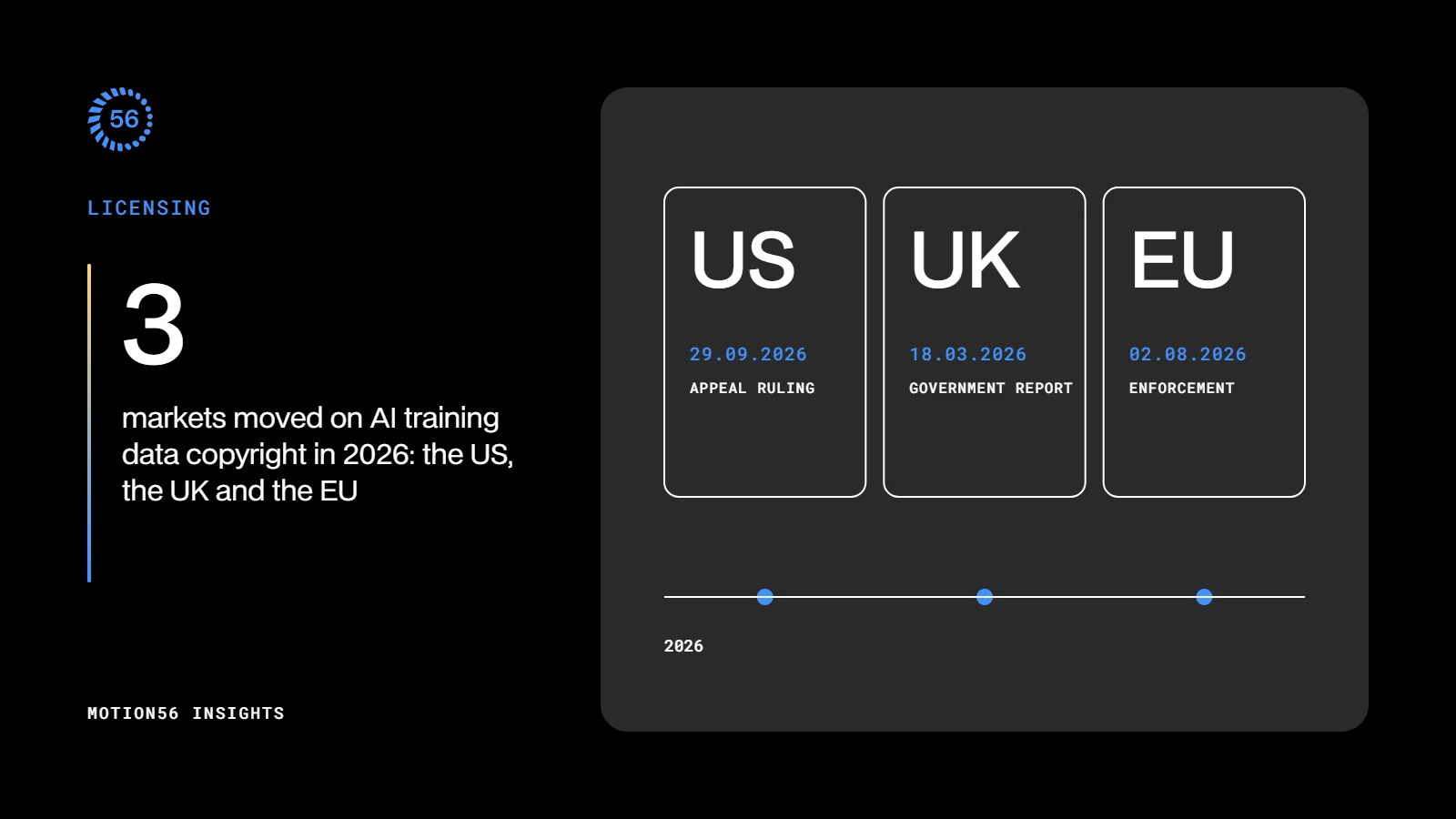
It depends where you train and what you build. In the UK, commercial AI training on protected works needs a licence. In the US, the first appeal ruling (29 September 2026) found training was not fair use where it harmed a developing market for training-data licences. EU rules now require a public summary of training content.
This is a summary for teams that buy and license training data. It is not legal advice, so take advice on your own position.
Is it legal to train AI on copyrighted video?
There is no single answer, because copyright is territorial. As the UK government's 2024 consultation put it, the law of the country where a model is trained applies to that training.
What changed in 2026 is that the three markets most AI teams deal with all moved, and each move put more weight on knowing where training data came from and on what terms.
What did the first appeal court decide?
On 29 September 2026 the US Court of Appeals for the Third Circuit ruled in the Ross Intelligence case, the first federal appeal ruling on fair use in AI training. Ross, a legal research start-up, was refused a licence to the Westlaw legal database. It then trained a competing search tool on material built from Westlaw's headnotes, the short summaries that editors write for each court decision.
The court upheld a finding that Ross's use of 2,243 of those headnotes was not fair use. Three of the four fair use factors went against Ross. The one that matters most to anyone licensing data is the fourth, harm to the market.
The court found harm not only to Westlaw itself but to a market for licensing content as AI training data. It found that market existed even though the owner had not licensed the headnotes to anyone.
The market for licensing headnotes as text to train AI is rapidly developing.
US Court of Appeals for the Third Circuit, 29 September 2026
The court was careful about scope. Ross's tool returned existing passages rather than generating anything new, and the court said its ruling does not decide the generative AI cases still in the courts. Even so, it is the first appeal court to treat a market for training data licences as something unlicensed copying can harm. The full opinion (No. 25-2153) is public.
What is the position in the UK?
In the UK, copying a protected work to train a commercial model needs the owner's permission. The existing text and data mining exception covers non-commercial research only.
The government consulted on a broad exception that would have let developers train on any work unless its owner opted out. On 18 March 2026 it published its Report on Copyright and Artificial Intelligence, which says that approach is "no longer the government's preferred way forward". No new exception was put in its place, so commercial training on protected works still needs a licence.
The main UK court ruling so far, a photo library's claim against Stability AI decided in the High Court on 4 November 2025, did not settle the training question. The court found that the model itself was not an infringing copy of the images it learned from, and it did not rule on training, because the training took place outside the UK.
What does the EU AI Act ask of model providers?
Since 2 August 2025, providers of general-purpose AI models in the EU have had two duties that bear on training data. Article 53 of the AI Act requires them to:
put in place a policy to comply with EU copyright law, including respecting rights holders who have opted out of text and data mining
publish a sufficiently detailed summary of the content used to train the model, on a template from the AI Office
The template is mandatory. The Commission's enforcement powers began on 2 August 2026, with fines of up to 3% of worldwide annual turnover or 15 million euros, whichever is higher. Models placed on the market before 2 August 2025 have until 2 August 2027 to publish their summaries.
Licensed or scraped: what changes for AI teams?
Scraped data is cheap to collect, but in 2026 it is harder to defend. A team that trains on licensed footage can show where it came from, who owns it and what the licence allows. That record is what the EU summary asks for and what UK law requires for commercial training. After the Ross ruling, the source of training data and the terms it was taken on are also part of a US fair use argument.
Licensed data has practical advantages too. It can arrive described and checked, which saves cleaning time, and it comes with a counterparty who stands behind it. Motion56 licenses video on written terms for AI training. We warrant the rights to what we license and indemnify buyers against copyright claims.
AI training data copyright: what to keep on file
Where each dataset came from, and on what terms.
Whether a licence was available, and whether you took one.
What the licence allows: training, fine-tuning, evaluation, for how long and where.
Consent records for identifiable people, where the licence relies on them.
For EU model providers, the information the public summary template asks for.
Our guide to how AI training data licensing works covers what a licence lets you do and what it usually rules out. For prices, see how much video training data costs, and for licensed footage, training data.