GDPR and AI training: what the rules say about people in video
GDPR and AI training meet whenever people can be identified in the data. The lawful basis, when faces and voices count as biometric data, and what European and UK regulators have said.
By Paul Botha,
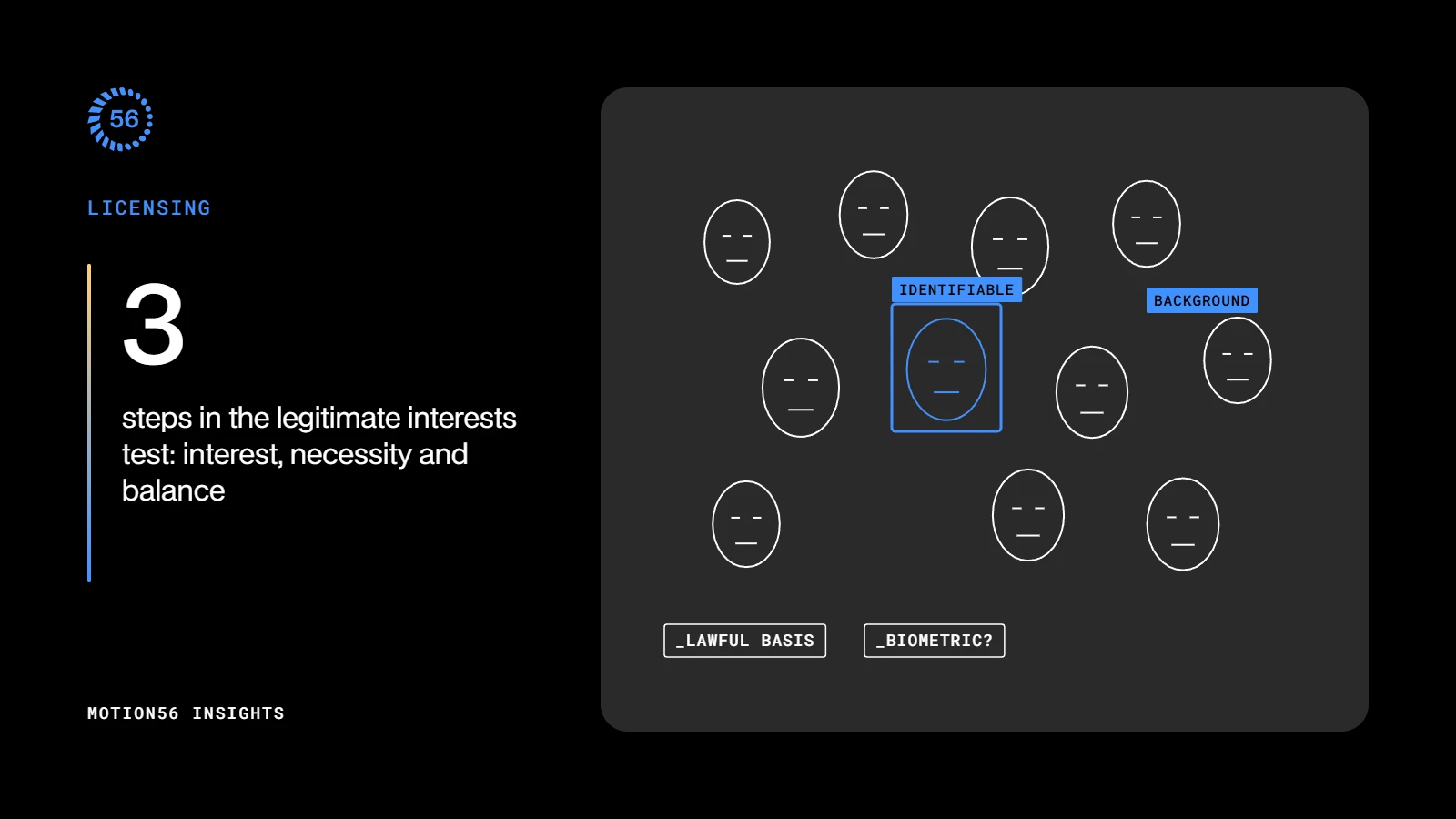
If people can be identified in your training video, GDPR applies to it. Developers usually rely on legitimate interests, which needs a three-step test. Faces and voices only become special category biometric data when processed to identify someone. Regulators also say a model trained on personal data is not automatically anonymous.
This is a summary for teams that buy and license training data, not legal advice.
What lawful basis do you need to train AI on video of people?
Most developers rely on legitimate interests. The European Data Protection Board's Opinion 28/2024, adopted on 17 December 2024, sets out a three-step test: a legitimate interest, necessity, and a balance against the rights of the people in the data. What people can reasonably expect counts, including whether the data was public, its context and its source.
In the UK, the Information Commissioner's Office concluded in December 2024 that legitimate interests is the only lawful basis available for training generative AI on web-scraped personal data, if the developer passes the three-part test. It also expects developers to show why other ways of collecting data are not suitable.
Does it matter if the footage was already public?
It counts, but it is not a free pass. The EDPB treats whether data was public as one factor in what people can reasonably expect, alongside the context and the source. The ICO goes further for scraped data, describing web scraping for generative AI training as high-risk, invisible processing, because the people in the data rarely know it is happening.
Is a model trained on personal data anonymous?
Not by default. The EDPB says a model only counts as anonymous if it is very unlikely that the people whose data trained it can be identified, or that their data can be pulled out of it through queries. That is assessed case by case.
AI models trained with personal data cannot, in all cases, be considered anonymous.
The opinion adds that unlawful training can affect whether the model may lawfully be used later, unless it has been properly anonymised.
Is a face or voice in a video biometric data under GDPR?
Only in some cases. Article 9 covers biometric data processed to uniquely identify a person, and Recital 51 says photographs are biometric data only when processed through specific technical means that allow unique identification. The ICO adds that digital photographs are not automatically biometric data, and lists voice recognition as a biometric technique.
So training a model to recognise who someone is brings in the stricter rules. Training it on video that happens to include people usually does not, although how this applies to generative models is still argued.
Does Illinois BIPA apply to AI training data?
It can. The Illinois Biometric Information Privacy Act covers voiceprints and scans of face geometry, but not photographs. Damages are $1,000 per negligent violation and $5,000 per intentional one. A 2024 amendment counts repeated collection from the same person as one violation, and in April 2026 a federal appeals court applied that change to cases already under way.
GDPR and AI training: what to ask a data supplier
Who appears in the footage, and can they be identified?
What lawful basis did the supplier rely on to collect and license it?
Are there releases or consents, and what do they cover?
Does the footage include children or sensitive settings?
Does the licence rule out identifying people?
How are removal requests handled after delivery?
The rules are still moving. On 21 October 2026 the Council of the EU agreed its position on a Digital Omnibus that includes clarifications on the lawful ground for processing personal data for AI. It is not law yet.
Motion56 licenses real-world video on written terms for AI training. Our guide to licensing your video archive for AI training covers the people who filmed and appear in footage, and AI training data copyright in 2026 covers the copyright side.