Open video datasets: which ones can you use commercially?
Open video datasets are easy to download and hard to use commercially. What the licences of the best-known sets allow, what happened to WebVid and what it means for commercial teams.
By Paul Botha,
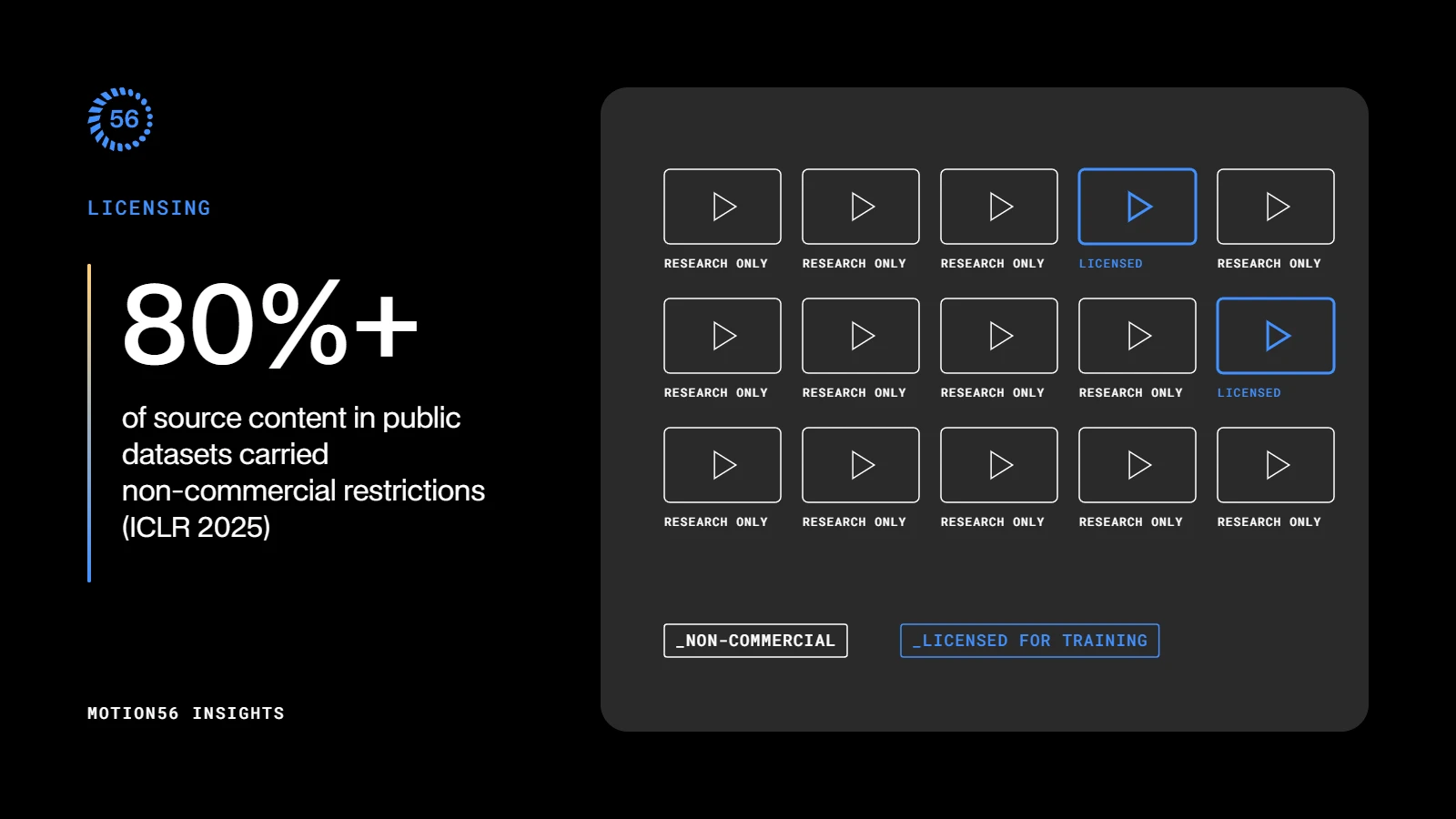
Fewer than most teams assume. Many open video datasets are licensed for non-commercial research only, and where a dataset licence is permissive it usually covers the labels or links, not the videos, whose creators keep their own rights. A 2025 audit found over 80% of source content carried non-commercial restrictions.
Can you use open video datasets for commercial AI training?
It depends on two layers of rights. The first is the dataset licence: the terms the people who built the dataset attach to their labels, captions, links or files. The second is the rights in the videos themselves, which belong to whoever filmed them. A permissive licence on the first layer does not clear the second.
A 2025 audit of about 4,000 public datasets, presented at ICLR 2025, found that 71% of video data came from YouTube. Fewer than a third of the datasets carried restrictive licences, but over 80% of the source content did, and for 65% of video hours the dataset licence did not match the restrictions of its source.
Which popular video datasets are research-only?
Panda-70M (2024): 70 million captioned clips, licensed for non-commercial research only, with no commercial licence granted.
HD-VILA-100M: the source of Panda-70M's videos. Its licence limits use to non-commercial research and treats models trained on the data as results of that research.
Ego4D: 3,670 hours of first-person video. Its draft licence allows some commercial product development for listed purposes, such as recognising objects and activities, but bars the data from appearing in any product and from being passed to others.
YouTube-8M and Kinetics: YouTube-8M is published under CC BY 4.0, but it distributes computed features, not videos. Kinetics is a list of labelled links to YouTube clips. The videos stay with their creators.
HowTo100M: 136 million clips from 1.2 million YouTube videos, with no licence specified on its public dataset card.
What happened to WebVid?
WebVid-10M, a set of about 10 million captioned stock footage clips widely used in text-to-video research, was taken down. Its maintainers say that after a cease-and-desist from the site the clips came from, they could no longer even provide the links from 23 February 2024.
The episode shows two things. A dataset that looks permanent can disappear, and the rights of the original owners sit underneath any dataset built from their work. The European Commission makes the same point in its template for AI model providers. Listing a publicly available dataset, it says,
Does not mean that the content at issue is necessarily free of rights.
European Commission, template for the public summary of training content, July 2025
Are YouTube videos fair game for training?
YouTube's own help pages say creators can choose to allow third-party AI training, that the setting is off by default and that YouTube's terms prohibit unauthorised downloading and scraping.
In April 2026 a group of YouTube creators filed a class action in the US District Court for Northern California over datasets built from YouTube videos, naming HD-VILA-100M, Panda-70M and HowTo100M. Those are allegations, not findings, but they show where the risk sits for anyone training on the same sets.
What should commercial teams do with open video datasets?
Read the dataset licence, then ask who owns the videos it points to.
Treat "research only" as meaning no commercial models, including ones trained during research and shipped later.
Keep a record of every dataset used, its licence and its source. The EU AI Act training content summary will ask for it.
Use open datasets for what they are good at: research and benchmarking. License the footage you build products on.
This is a summary, not legal advice. Licensed footage settles the second layer of rights as well as the first. Motion56 licenses real-world video on written terms for AI training, warrants the rights to what it licenses and indemnifies buyers against copyright claims. Our guide to how AI training data licensing works explains what a licence covers, and AI training data copyright in 2026 covers the law.