Metadata for AI training data: what buyers need
Metadata for AI training data decides whether footage can be found, priced and licensed. The four kinds AI teams ask for, what each costs and the rights detail that should travel with every clip.
By Paul Botha,
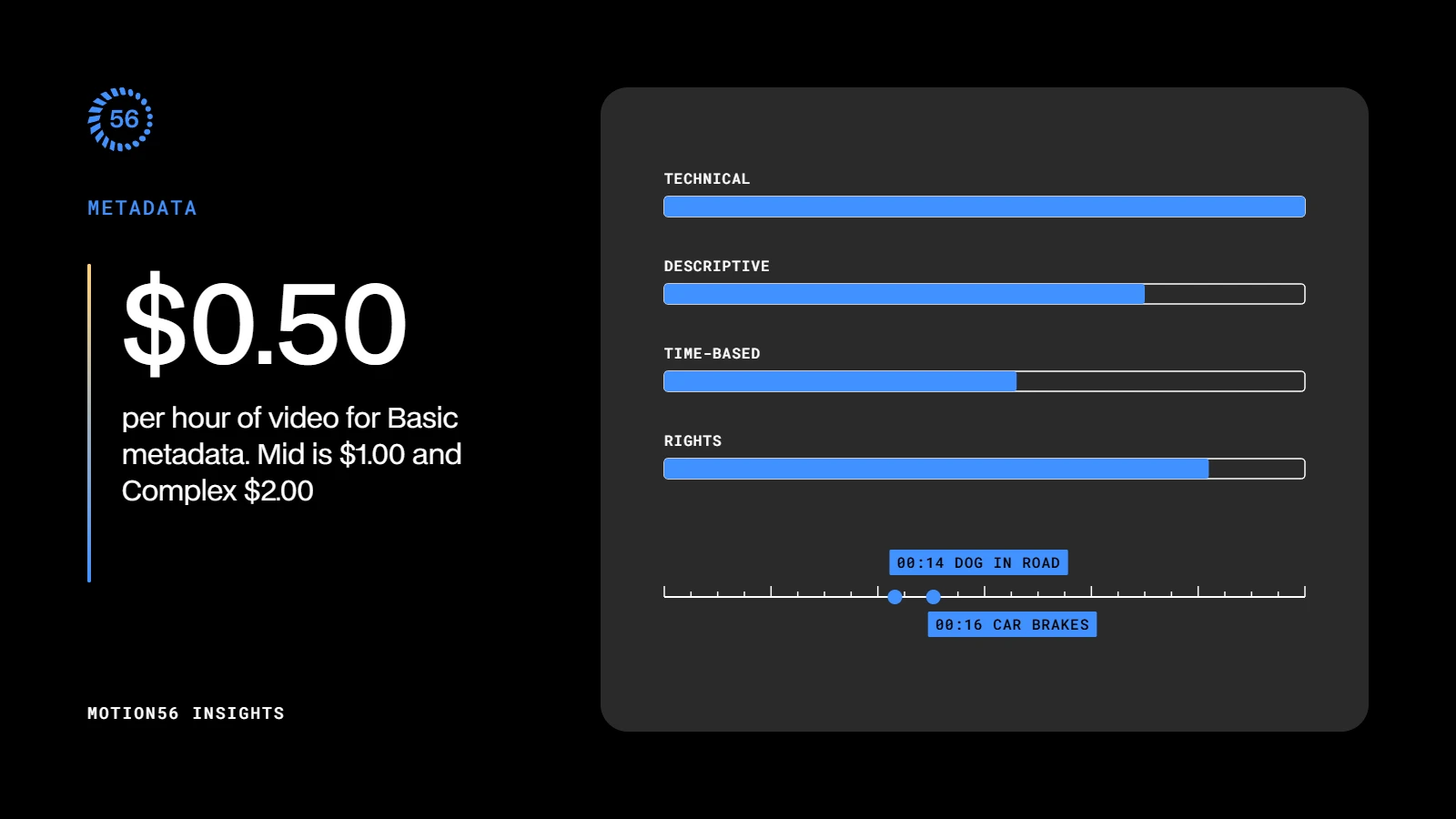
AI teams search footage by what happens in it, so they ask for four kinds of metadata: technical (format, length, frame rate), descriptive (tags, summaries, transcripts), time-based (what happens when) and rights (who owns it and what the licence allows). Without it, footage is hard to find, price or license.
What metadata do AI teams ask for?
Technical. Read from the file: resolution, frame rate, codec, duration and audio tracks. Teams filter on these first.
Descriptive. What the clip shows: tags, a summary and a transcript of any speech.
Time-based. What happens when: the objects in frame and the events, with timings, so a team can pull the few seconds it needs.
Rights. Who owns it, where and when it was filmed, who appears in it and what the licence allows.
What is the difference between metadata and annotation?
Metadata describes a clip so it can be found and selected. Annotation labels what is inside it, frame by frame, for a model to learn from directly: boxes around objects, outlines, and points on hands and faces.
Annotation is usually done for one model, after the footage has been chosen. Metadata comes first, because nobody can annotate footage they cannot find. Good metadata also tells a team which clips are worth annotating at all.
Why do time-based descriptions matter?
A tag tells a buyer that a clip contains a dog. A time-based description tells them the dog runs into the road at 0:14 and a car brakes at 0:16. For training data, the second is what makes a clip selectable against a brief.
It also decides how much footage has to be reviewed to fill a brief. In January 2026, The Media Leader reported that Veritone processed 500,000 hours of video to deliver 26,000 hours for one model, and that it prices video from $1 to $1,000 an hour depending on the use and the tagging and metadata available.
What does metadata for AI training data cost?
Motion56's AI-training-ready video metadata is priced per hour of video, in three tiers:
Basic, $0.50 an hour: technical metadata, asset identification and descriptive tags.
Mid, $1.00 an hour: Basic, plus summaries and full audio transcription.
Complex, $2.00 an hour: Mid, plus objects, brand flags, sentiment and event timelines.
Vector embeddings, which let your own systems search the footage by meaning, are $0.10 an hour on top. Set-up, storage and moving data are quoted separately. The service reads from cloud storage, and a sample is checked during scoping so your team can review it before the full run.
Metadata services stand on their own. You do not have to license your footage through Motion56, and if you decide to license later, the metadata is already done.
What rights information should travel with every clip?
Buyers increasingly have to account for what they trained on. Under Article 53 of the EU AI Act, providers of general-purpose AI models must publish
A sufficiently detailed summary about the content used for training.
That duty has been enforceable since 2 August 2026, and it is far easier to meet when each clip arrives with its rights detail:
The owner, and the chain of rights from the person who filmed it.
Where and when it was filmed.
Whether identifiable people appear, and what they agreed to.
What the licence allows: training, evaluation, term and territory.
Anything excluded, such as music or third-party material.
Where to start
If you hold an archive, our guide to licensing your video archive for AI training explains how metadata fits into the process, and our post on what buyers look for covers which footage sells. For the legal background, see AI training data copyright in 2026.
To make your own archive searchable, tell us about it through metadata services. We reply to every enquiry about an archive within one working day.