What is egocentric video data, and who needs it?
Egocentric video data is first-person footage from head, chest and helmet cameras. Why robotics and world model teams want it, how much exists and what to check before you license it.
By Paul Botha,
Egocentric video is footage filmed from the point of view of the person doing something, usually on a head, chest or helmet camera. It shows hands, objects and movement as the person sees them, which is the view a robot or a wearable assistant has. That makes it training data for robotics, world models and augmented reality.
What is egocentric video data?
Most video is filmed by someone watching an event. Egocentric video is filmed by someone taking part in it. The camera moves with the person's head or body, their hands are often in shot, and the scene is seen from the distance and angle they saw it. Researchers also call it first-person or point-of-view video.
That viewpoint is what makes it useful, and it is also what makes it different. The team behind Ego4D, the largest open egocentric dataset, noted that wearable camera video has unusual viewpoints and motion blur and lacks the editing of ordinary video. Models trained only on third-person video do not transfer well to it.
Why do robotics and world models need egocentric video data?
A robot learning to load a dishwasher sees the task from roughly where a person's eyes would be, with its own hands in front of it. Video of people doing the same task from that angle is the closest thing to the robot's own experience that exists at scale. Robot data, recorded by operating real robots, is slower and more expensive to collect, because every hour needs a robot and an operator.
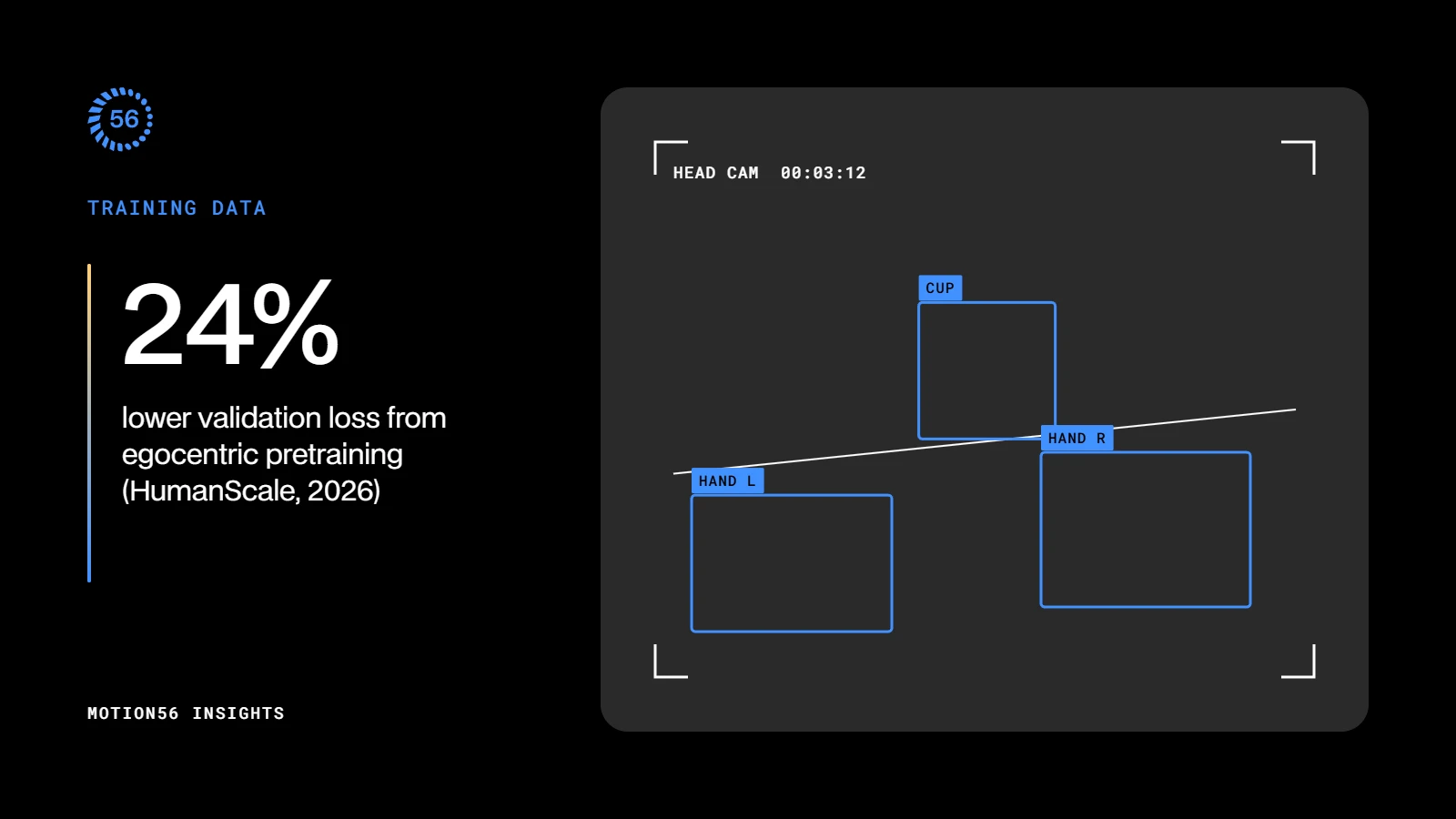
Recent research supports the swap. In June 2026 the authors of HumanScale compared egocentric human video with real-robot data as pretraining material. With the same amount of data, models pretrained on egocentric video reached 24% lower validation loss on real-robot action prediction. They also had 52.5% and 90% higher success rates on in-distribution and out-of-distribution tasks.
Not merely a viable substitute for model pretraining but can lead to superior performance.
Ma et al., HumanScale, June 2026, on egocentric human video
World model builders use egocentric video for a related reason: it shows how the world responds when a person acts on it. 1X, which builds home robots, said in January 2026 that it trained its world model on 900 hours of egocentric human video to align it with first-person manipulation tasks.
How much egocentric video exists?
The largest open set, Ego4D, holds 3,670 hours of daily-life video recorded by 931 camera wearers in 74 locations across 9 countries. When it was published in 2022 it was an order of magnitude larger than any egocentric dataset before it. Access is under the project's own licence agreement.
Commercial teams that need more have two other sources:
Collection to order. Companies pay people to wear cameras while they cook, clean or work, and deliver the footage with consent records. It can be specified exactly, but every hour has to be filmed.
Licensing footage that already exists. People have filmed their own activities on head, chest and helmet cameras for years. That footage was not staged for a dataset, so it covers places, tasks and conditions a collection brief would not think to ask for.
What should you check before licensing egocentric video?
Mounting. Head, chest, helmet and vehicle cameras give different views. Say which ones your model needs.
Hands and objects. For manipulation work, ask how much of the footage has hands and objects in frame.
Sound. Natural sound gives a second signal for audio-visual tasks.
Extra signals. Some teams need motion sensor data, gaze or camera calibration. Ask whether it exists rather than assume it does.
Description. Time-based descriptions of what happens, so you can select footage by action.
Rights and people. Who filmed it, who appears in it and what they agreed to.
Egocentric video at Motion56
Egocentric is one of Motion56's four data sets, alongside Human-centric, Natural world and Broadcast. It is the view from the person doing it: head, chest, helmet and dash cams, with the natural sound of the scene, showing how people move, handle objects and find their way.
Tell us the activities, settings and signals your model needs, and we will reply within one working day with what we hold and the route to a sample. See training data for the four data sets, our guide to how AI training data licensing works for what a licence covers, and AI training data copyright in 2026 for the legal background.