Deepfake detection training data: why the real class matters
Deepfake detection training data decides how a detector performs outside the lab. Why detectors that score well on benchmarks fail on real social video, and what the real class should contain.
By Paul Botha,
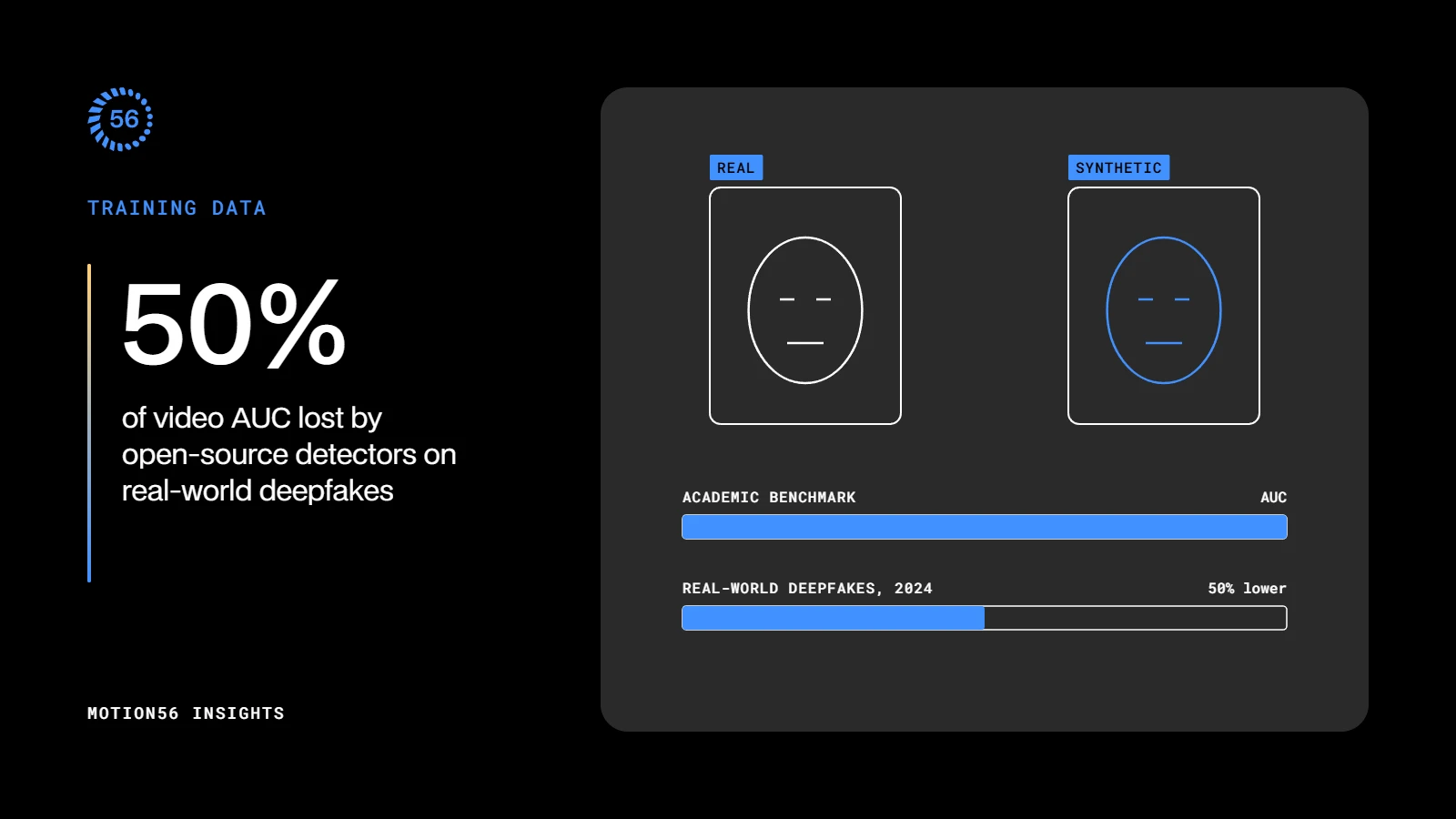
Most deepfake detectors are trained on academic sets with small, clean real classes, then meet compressed, re-encoded social video. On a 2024 benchmark of real-world media, open-source detectors lost about half their AUC: 50% for video, 48% for audio and 45% for images. Models trained on representative real-world media did better.
Why do deepfake detectors fail in the wild?
A detector learns two things at once: what manipulated media looks like, and what real media looks like. If either side of that lesson is narrow, the detector fails on anything outside it.
Deepfake-Eval-2024 measured the problem. It was built from deepfakes that circulated on social media and detection platforms in 2024, and contains 45 hours of video, 56.5 hours of audio and 1,975 images from 88 websites in 52 languages. Tested on it, open-source detectors lost 50% of their AUC for video, 48% for audio and 45% for images compared with earlier benchmarks.
These academic benchmarks are out of date and not representative of real-world deepfakes.
Chandra et al., Deepfake-Eval-2024
Other studies point the same way. A benchmark built from Instagram, TikTok, YouTube and Facebook content found that even the strongest detectors lost 15% to 20% of their accuracy on platform media. A June 2026 study in Frontiers in Artificial Intelligence found detectors breaking down under ordinary compression, noise and blur.
What is the real class, and why does it go stale?
The real class is the authentic media a detector learns to accept. In the academic sets it is small. FaceForensics++, one of the most used, has 1,000 original videos. Celeb-DF v2 has 590. The June 2026 study notes that sets like these lack the variety of lighting, compression and noise found on real platforms.
Real media also changes. New phones, new camera processing and new platform encoders all alter what an authentic video looks like at the level a detector reads. A real class that matched the world three years ago may not match it today, so it needs refreshing as devices and platforms change.
What should deepfake detection training data include?
Many devices. Footage from many makes and generations of phone and camera, each with its own processing.
Platform history. Video that has been uploaded, re-encoded and downloaded, the way real media travels.
Fixed cameras. CCTV and dashcam footage, which looks nothing like a face filmed for a benchmark.
Hard conditions. Low light, crowds, motion, weather and partly hidden faces.
Speech. Many languages and accents with the original audio, for audio and audio-visual detectors.
Refresh. New footage each year, so the real class keeps pace.
How does the EU AI Act change demand?
The AI Act's transparency rules became enforceable on 2 August 2026. Providers of AI systems that generate synthetic audio, images or video must mark that content in a machine-readable way so it can be detected, and deployers must disclose deepfakes. Systems already on the market before 2 August 2026 have until 2 December 2026 to comply with the marking and detection rules.
Marking only covers content from providers that comply. Fakes made with tools that do not mark their output still have to be detected from the media itself, and those detectors still need real footage to learn from.
How should a detection team license real video?
Ask for footage described by device, source and conditions, so you can build a real class that matches what your customers see.
Ask how and by whom it was filmed.
License it for training, evaluation and benchmarking, so the same footage can test the next model.
Agree how often new footage will be added.
Motion56 licenses real-world video filmed by the people who were there, on many makes of phone and camera, including CCTV and dashcam footage, with the original audio. We warrant the rights to what we license and indemnify buyers against copyright claims. Send your brief through training data and we will reply within one working day.
For the legal background, see AI training data copyright in 2026, and for prices, how much video training data costs.